

Renewable Energy Project Lifecycle: From Land Identification to Power Generation
Have you ever wondered what actually happens after a renewable energy developer identifies a piece of land? Contrary to popular belief, a solar or wind farm isn't built overnight. Developing a utility-scale renewable energy project involves months—and often years—of planning, technical assessments, legal verification, environmental studies, engineering, construction, and grid integration. This guide walks through every stage of a renewable energy project's lifecycle, helping landowners understand the complete journey from an empty piece of land to a fully operational clean energy asset.
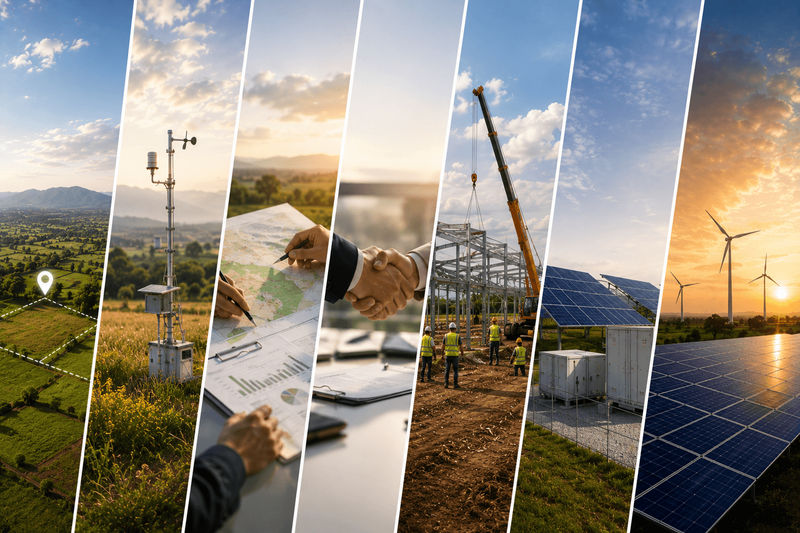
Introduction
When people see a completed solar park or a row of wind turbines, they usually notice only the final result. What they don't see is the extensive planning that happened long before construction began. Behind every successful renewable energy project lies a carefully managed process involving engineers, surveyors, legal experts, environmental specialists, financial institutions, government agencies, EPC contractors, and local communities. For utility-scale projects, development is rarely a single event. It is a structured journey that transforms a promising location into a power-generating asset capable of supplying electricity for 25 years or more. Understanding this lifecycle helps landowners appreciate why developers conduct detailed assessments before making commitments and why patience is often essential during project development.
Why Project Planning Matters
Renewable energy projects involve significant investment. Developers therefore seek to minimise technical, legal, environmental, and financial risks before construction begins. Proper planning helps:
- Improve project viability
- Reduce delays
- Lower costs
- Ensure regulatory compliance
- Maximise energy generation
- Improve long-term reliability
Every stage builds upon the previous one.
Stage 1: Land Identification
The journey begins by identifying land that may be technically suitable. Developers typically evaluate:
- Solar irradiation
- Wind resource
- Contiguous land availability
- Terrain
- Road connectivity
- Nearby substations
- Transmission lines
- Environmental constraints
Modern tools such as GIS mapping and satellite imagery help screen thousands of acres before field visits begin.
Stage 2: Preliminary Technical Assessment
Once promising land is identified, engineers conduct a high-level feasibility assessment. This may include:
- Topographic review
- Renewable resource analysis
- Infrastructure mapping
- Flood risk assessment
- Accessibility review
- Grid proximity analysis
Sites that meet the initial criteria move to the next stage.
Stage 3: Landowner Engagement
Developers begin discussions with landowners to understand:
- Ownership structure
- Land boundaries
- Existing land use
- Willingness to participate
- Documentation availability
Transparent communication during this stage is essential for building long-term relationships.
Stage 4: Legal Due Diligence
Before investing further, developers verify the legal status of the land. This generally includes reviewing:
- Ownership records
- Revenue documents
- Survey records
- Encumbrances
- Land classification
- Applicable approvals
Legal clarity is one of the most important requirements for project success.
Stage 5: Detailed Surveys
Field teams then conduct detailed engineering studies. These may include:
- DGPS surveys
- Topographical surveys
- Soil investigations
- Geotechnical analysis
- Hydrological assessments
- Drone surveys
The information collected supports engineering design and construction planning.
Stage 6: Environmental & Regulatory Assessments
Depending on the project and applicable regulations, developers may complete:
- Environmental studies
- Biodiversity assessments
- Statutory approvals
- Utility coordination
- Government permissions
Responsible planning ensures projects are developed sustainably.
Stage 7: Financial Planning
Renewable energy projects require significant capital investment. Developers evaluate:
- Engineering costs
- Equipment procurement
- Transmission infrastructure
- Construction budgets
- Financing options
- Long-term revenue projections
Financial closure is typically achieved before major construction begins.
Stage 8: Engineering & Design
Detailed engineering converts survey data into construction-ready plans. This includes designing:
- Solar panel layouts
- Wind turbine locations
- Internal roads
- Drainage systems
- Cable routes
- Substations
- Transmission connections
- Control buildings
Engineering optimisation helps maximise energy generation while reducing costs.
Stage 9: Procurement
Developers procure key equipment such as:
- Solar modules
- Wind turbines
- Inverters
- Transformers
- Mounting structures
- Electrical cables
- Switchgear
- SCADA systems
Reliable supply chains are critical for maintaining project schedules.
Stage 10: Construction
Construction activities vary by project type but typically include:
- Site preparation
- Internal road construction
- Civil foundations
- Electrical installation
- Equipment erection
- Cable laying
- Substation construction
This phase often creates significant employment opportunities.
Stage 11: Grid Connection
Once construction is complete, the project is connected to the electricity grid. Key activities include:
- Testing electrical systems
- Energising substations
- Grid synchronisation
- Performance verification
- Protection system testing
Only after successful commissioning can electricity be exported to the grid.
Stage 12: Operations & Maintenance
The operational phase usually lasts several decades. Routine activities include:
- Equipment monitoring
- Preventive maintenance
- Performance analysis
- Vegetation management
- Security
- Cleaning
- Drone inspections
- AI-enabled monitoring
Continuous maintenance helps maximise long-term energy generation.
Stage 13: Performance Optimisation
Modern renewable energy projects use:
- Artificial Intelligence
- SCADA systems
- Predictive maintenance
- Weather forecasting
- Digital twins
- Battery optimisation
These technologies continuously improve plant efficiency throughout its operational life.
Stage 14: End-of-Life Planning
After decades of operation, developers evaluate options such as:
- Equipment replacement (repowering)
- Technology upgrades
- Asset decommissioning
- Site restoration
- Continued project operation, where appropriate
End-of-life planning is typically addressed through project agreements and applicable regulations.
- Typical Renewable Energy Project Timeline
- Project Stage
- Typical Duration*
- Land Identification
- Weeks to Months
- Technical & Legal Studies
- Several Months
- Engineering & Approvals
- Several Months
- Procurement
- 3–9 Months
- Construction
- 6–18 Months
- Operations
- 25+ Years
*Actual timelines vary depending on project size, approvals, and site conditions.
What This Means for Landowners
Understanding the project lifecycle helps explain why developers request technical surveys, legal documents, and multiple site visits before construction begins. Every stage is designed to reduce risk and ensure the project is technically, legally, environmentally, and commercially viable. Patience during the development process often contributes to smoother project execution for everyone involved.
How Velante NRG Supports Every Stage of Development
At Velante NRG, we support renewable energy development through a comprehensive, technology-driven approach. From GIS-based land identification and satellite analysis to legal due diligence, technical feasibility studies, developer coordination, and infrastructure assessment, our process is designed to identify land that is genuinely suitable for utility-scale solar, wind, and hybrid energy projects. By combining engineering expertise with transparent communication, we help bridge the gap between landowners and developers while contributing to responsible, long-term renewable energy growth across India.
Frequently Asked Questions
How long does a renewable energy project take to develop?
Development timelines vary depending on project size, approvals, financing, and construction complexity. Utility-scale projects typically require months to a few years before commercial operation.
Why do developers conduct so many surveys?
Surveys help verify land suitability, optimise engineering design, reduce project risks, and ensure compliance with technical and regulatory requirements.
When does construction begin?
Construction generally starts after technical studies, legal verification, financing, engineering design, and required approvals have been completed.
What happens after a project becomes operational?
The project enters a long-term operations and maintenance phase, during which its performance is continuously monitored, maintained, and optimised to ensure reliable electricity generation.
Conclusion
A renewable energy project is far more than a construction exercise—it's a carefully coordinated process involving technology, engineering, legal due diligence, environmental planning, financing, and long-term operations. Every stage, from identifying suitable land to delivering clean electricity to the grid, plays a critical role in ensuring the project's success. For landowners, understanding this lifecycle provides greater confidence and clarity when engaging with renewable energy opportunities. At Velante NRG, we combine advanced land assessment, technical expertise, and transparent processes to support responsible renewable energy projects that create lasting value for communities while helping power India's clean energy future.
Table of Contents