
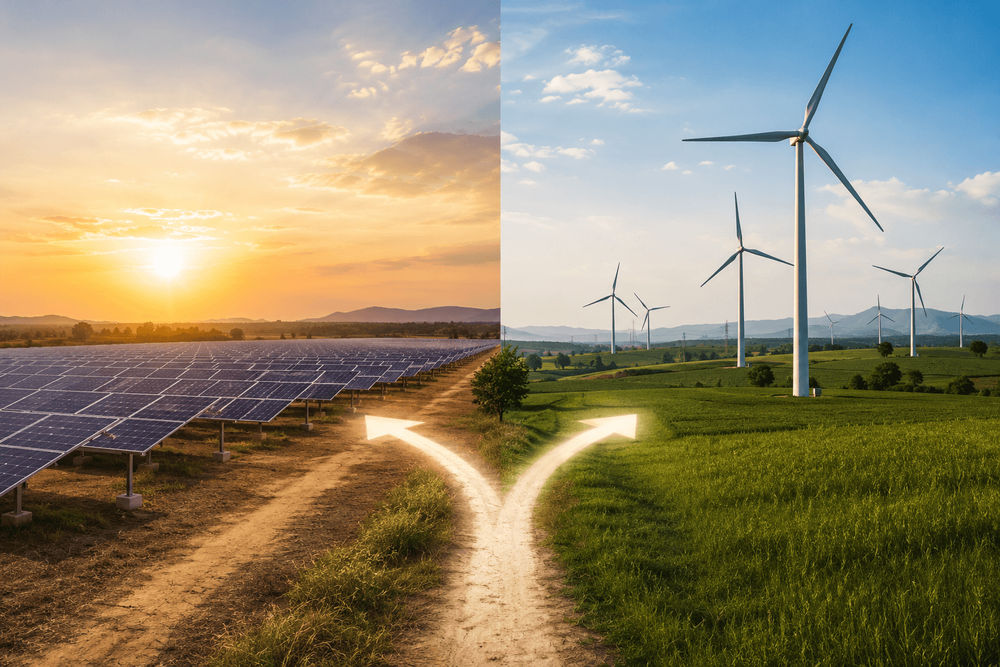
India's renewable energy sector is expanding faster than ever, creating new opportunities for landowners. But should your land be used for a solar farm or a wind farm? The answer depends on several factors including location, wind resources, solar irradiation, land characteristics, and nearby infrastructure. This guide compares both technologies using real-world data, industry trends, and practical insights to help landowners understand how developers evaluate land and why professional assessment is essential.
Introduction
India is undergoing one of the fastest renewable energy transitions in the world. As electricity demand continues to rise and industries increasingly seek clean power, the country is investing heavily in both solar and wind energy. The numbers tell the story. By the end of FY 2024–25, India's installed renewable energy capacity had reached 220.1 GW, with solar power contributing over 106 GW and wind power crossing the 50 GW milestone for the first time. India added nearly 30 GW of renewable capacity in a single financial year, the highest annual addition in its history. Globally, renewable energy is expanding at an unprecedented pace. In 2025 alone, the world added approximately 800 GW of new renewable capacity, with solar accounting for more than 75% of all new installations and wind contributing around 20%. Behind every megawatt of clean electricity lies a critical resource—land. For landowners, one question frequently arises:
Would my land be more suitable for a solar farm or a wind farm?
The answer depends on much more than available acreage. Geography, weather patterns, topography, infrastructure, environmental regulations, and long-term project economics all play an important role.
India's Renewable Energy Growth by the Numbers
- Key Statistics
- Indicator
- Latest Figure
- Total Renewable Energy Capacity
- 220.1 GW
- Installed Solar Capacity
- 106 GW+
- Installed Wind Capacity
- 50 GW+
- Renewable Capacity Added in FY 2024–25
- 29.5 GW
- National Target by 2030
- 500 GW Non-Fossil Capacity
India's clean energy expansion is accelerating at an exceptional pace. These figures demonstrate why demand for suitable land is increasing every year. Utility-scale renewable projects require extensive land, making professionally evaluated sites increasingly valuable.
Understanding Solar Farms
A solar farm consists of thousands of photovoltaic (PV) panels installed across a carefully designed site to convert sunlight directly into electricity. Unlike rooftop solar systems, utility-scale solar parks can generate hundreds of megawatts of electricity, supplying industries, businesses, and the national power grid. Solar projects are generally easier to develop because sunlight availability can be predicted accurately using decades of meteorological data. Modern engineering techniques also allow developers to maximise generation through optimal panel orientation and tracking systems. Today, solar has become the dominant renewable energy technology worldwide. In 2025, it represented more than three-quarters of all new renewable capacity additions globally.
Understanding Wind Farms
Wind farms generate electricity by converting the kinetic energy of moving air into electrical power through turbines. Unlike solar energy, wind performance depends on highly location-specific conditions. Developers analyse wind speed, direction, seasonal consistency, turbulence, and long-term weather patterns before selecting suitable sites. Modern wind turbines are significantly larger and more efficient than earlier generations, allowing developers to generate more electricity from fewer turbines. However, successful wind projects require careful planning, specialised engineering, and favourable wind resources. India added more than 6 GW of new wind capacity during 2025, reflecting renewed momentum in the sector after several slower years.
- Solar vs Wind: A Detailed Comparison
- Factor
- Solar Farm
- Wind Farm
- Primary Resource
- Sunlight
- Wind
- Best Locations
- High solar irradiation regions
- High wind corridors
- Typical Construction Time
- 12–18 months
- 18–30 months
- Land Requirement
- Large continuous parcels
- Larger geographic area with turbine spacing
- Moving Components
- Minimal
- Turbines have rotating mechanical components
- Maintenance
- Comparatively lower
- More specialised maintenance
- Power Generation Pattern
- Daytime generation
- Day and night depending on wind conditions
- Infrastructure
- Panels, inverters, substations
- Turbines, foundations, substations
Which Type of Land Is Better for Solar?
Developers generally prefer land with:
- High annual solar irradiation
- Flat or gently sloping terrain
- Minimal shading
- Good road connectivity
- Proximity to transmission infrastructure
- Clear legal ownership
Large contiguous parcels simplify engineering design and reduce construction costs. Regions such as Rajasthan, Gujarat, Karnataka, Andhra Pradesh, and parts of Maharashtra have become major destinations for utility-scale solar development because of favourable climatic conditions and expanding transmission networks.
Which Type of Land Is Better for Wind?
Wind projects require a different set of characteristics. Developers evaluate:
- Long-term average wind speeds
- Wind consistency throughout the year
- Elevation
- Terrain roughness
- Distance between turbine locations
- Transportation access for oversized equipment
States including Tamil Nadu, Gujarat, Karnataka, Maharashtra, and Rajasthan continue to lead India's wind energy development because of favourable wind resources.
Environmental Impact: Solar vs Wind
Both technologies play a significant role in reducing greenhouse gas emissions and dependence on fossil fuels. Solar farms produce electricity without combustion, consume relatively little water during operation, and have become increasingly efficient over the past decade. Wind farms generate electricity without direct emissions and often allow surrounding land to remain available for compatible agricultural activities, depending on project design. From a climate perspective, both technologies contribute to India's broader clean energy goals and support the country's pathway toward 500 GW of non-fossil fuel capacity by 2030.
Why Location Matters More Than Technology
A common misconception among landowners is that they can choose whether their land becomes a solar farm or a wind farm. In reality, developers first determine what the land is capable of supporting. A parcel with excellent solar resources but weak wind speeds is unlikely to be considered for wind development. Likewise, a high-wind corridor with suitable elevation may offer stronger long-term potential for wind energy. Professional assessment considers multiple datasets simultaneously, including:
- Satellite imagery
- Solar resource mapping
- Wind resource analysis
- Topography
- Grid connectivity
- Environmental constraints
- Legal documentation
- Accessibility
Only after these evaluations can developers determine the most suitable project type.
India's Renewable Energy Future Means Greater Opportunities for Landowners
The International Energy Agency projects India to become one of the world's fastest-growing renewable energy markets, with renewable capacity expected to increase by approximately 2.5 times by 2030. As this expansion continues, demand for technically suitable land is expected to grow significantly. For landowners, this represents an opportunity not only to generate recurring income through renewable energy leasing but also to participate directly in India's transition toward a cleaner and more sustainable energy system.
How Velante NRG Helps Landowners Make the Right Decision
At Velante NRG, we understand that every parcel of land has unique characteristics. Rather than assuming suitability, our team conducts comprehensive technical and legal evaluations to determine the most appropriate renewable energy opportunity. By analysing solar and wind resource potential, accessibility, ownership records, surrounding infrastructure, and project feasibility, we help landowners understand the true potential of their land before engaging with developers. Our goal is not simply to connect land with projects, but to create transparent, informed partnerships that generate long-term value for landowners while supporting India's renewable energy ambitions.
Frequently Asked Questions
Can I decide whether my land becomes a solar or wind project?
Not entirely. The decision depends on technical feasibility, natural resources, infrastructure, and developer requirements.
Does wind require more land than solar?
Wind farms generally require greater spacing between turbines, although much of the surrounding land may still be used for compatible purposes, depending on the project design.
Is solar growing faster than wind?
Yes. Solar has been the fastest-growing renewable technology both globally and in India. It accounted for the majority of India's recent renewable capacity additions and more than three-quarters of global renewable additions in 2025.
Which technology generates more electricity?
It depends on the local resource. High solar irradiation favours solar projects, while regions with consistently strong winds may be better suited for wind energy. Professional resource assessments determine which technology offers the greatest long-term potential.
Conclusion
The question is not whether solar is better than wind or vice versa—the real question is which technology is best suited to your land. Every renewable energy project begins with understanding the land itself. Factors such as natural resources, terrain, accessibility, legal clarity, and transmission infrastructure all influence project viability. By combining these assessments with India's rapidly growing demand for clean energy, landowners can unlock opportunities that create long-term economic value while contributing to the country's sustainable future. At Velante NRG, we believe every acre deserves a thorough evaluation before decisions are made. With technical expertise, transparent processes, and strong industry partnerships, we help landowners identify the renewable energy opportunity that best matches their land—ensuring that every project begins with confidence and every partnership is built to last.
Table of Contents